
How to Support Communication for Learners Using this ASL tool in the Classroom

A big shift that you can support in your classroom (and that you will find in any well-run special education classroom) is moving from reactive teaching to system-based teaching.
Instead of constantly responding to behaviors, frustrations, and communication breakdowns, you CAN create systems that will likely prevent those challenges from happening in the first place.
All forms of communication are not created equal. You will have students in your class who will benefit from multiple different types of modalities. This post is for the students in your care who are learning how to communicate using ASL.
For those learners using ASL, in the classroom, it is not just a communication tool - it needs to become part of your daily classroom system.
When it is used consistently for those learners, it supports:
Your morning routine
Your transition expectations
Your behavior support system
Your communication expectations
Your independence goals
Life outside of the classroom
Think about your day.
You likely already have systems for:
Morning meeting
Centers
Visual schedules
Behavior expectations
But communication?
That’s often where things are inconsistent simply because in your setting, all students are communicating differently.
Adding consistent use of ASL for those specific learners creates a layer of support across your entire day.
Instead of:
Repeating directions multiple times
Trying to guess what a student needs
Managing frustration-based behaviors
You now have a consistent, shared way to communicate.
And that changes everything.
ASL vs. Other Communication Supports
You might be wondering:
“How does ASL compare to other communication supports like PECS or AAC?”
The truth is - ASL is not meant to replace other systems. It is also not going to be an appropriate fit for every child. Communication for your students will never be a one sized fits all approach.
But for those learning ASL, it can work alongside them.
Here’s how it fits: (for those learners that it is appropriate for)
ASL + Visual Supports
Using ASL with visuals helps students:
Make stronger connections between words and meaning
Transition between communication systems more easily
Generalize skills across settings
ASL + AAC Devices
For students using AAC:
ASL can support quick communication without needing a device
It reduces reliance on technology in certain moments
It gives students another way to express themselves
ASL + Verbal Speech
For verbal students:
ASL strengthens vocabulary and comprehension
It supports expressive language
It can help bridge communication gaps
The key takeaway:
You don’t have to choose one system. ASL can simply enhance the systems you are already using when appropriate.
Keep in mind, ASL is NOT appropriate for all learners. Please ensure you are communicating with your SLP very closely to determine if it is an appropriate form of paired communication.
What to Teach First (Functional ASL Vocabulary)
Trying to introduce and teach too many signs at once can lead to overwhelm, inconsistency and low carryover across settings.
Instead, focus on high-impact, functional communication first.
Start with signs that students will use multiple times per day.
Core Communication Signs (a few examples)
Please work with your SLP to determine an appropriate list of core words that are appropriate for your specific student in mind
Help
More
All done
Stop
Go
Basic Needs
Eat
Drink
Bathroom
Break
Social Communication
Yes
No
Like
Don’t like
Classroom Language
Sit
Wait
Finished
Listen
These signs can immediately:
Increase independence
Reduce frustration
Improve participation
Once those are consistent, then, you can expand.
How to Get Support From Your Team
Let's be honest about something here...
Even the best system won’t work if your team isn’t using it.
And in many classrooms, you may have:
Multiple paraprofessionals
Related service providers
Substitute teachers
So how do you get everyone on board? This was always a HUGE challenge for me. I experienced a new substiute almost daily in my classroom for YEARS. The paraprofessional door was always swinging with new people in and out. In my setting I only had part time paras, who worked for minimum wage, no benefits, etc.. The fit was typically never the right one.
1. Keep It Simple
Don’t introduce 50 signs at once.
Start with 5–10 key signs and build from there.
2. Provide a Visual Reference
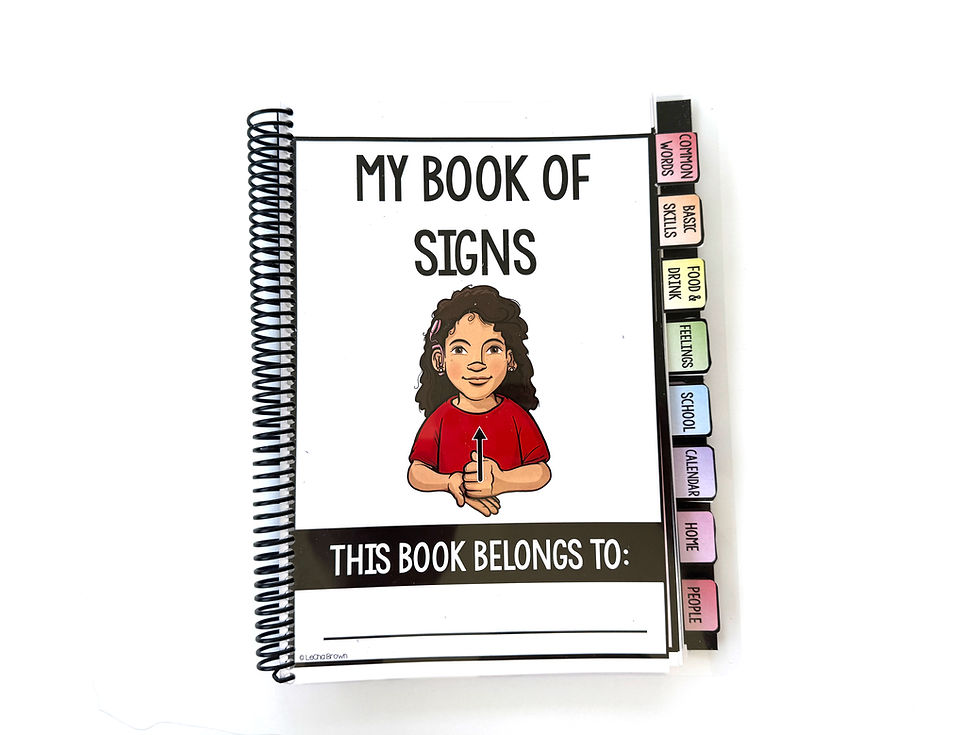
This is where your ASL Communication Book becomes essential.
Instead of:
Explaining signs verbally
Hoping everyone remembers
You have a clear, visual system that anyone can follow.
3. Model, Don’t Just Tell
Your team will follow your lead if you are consistent.
If you are consistently:
Signing
Pairing speech with signs
Reinforcing student use
They will start doing the same. Continue to reinforce the importance of this to them.
4. Build It Into Your Routine
Make ASL part of what you already do.
Use it during:
Morning meeting
Transitions
Centers
Snack
When it’s embedded into routines, it becomes automatic.
Supporting Families at Home
One of the most powerful things about ASL is that it doesn’t have to stay in the classroom.
It can carry over into the home.
And that’s where real progress happens.
But here’s the challenge:
Many parents want to support communication - but they don’t know how.
They may feel:
Overwhelmed
Unsure where to start
Inconsistent with implementation
That’s why providing a tool like an ASL Communication Book is so impactful.
It gives families:
A clear starting point
A visual reference
Confidence to support their child
And when communication is supported at both school and home:
✔ Skills generalize faster
✔ Your learners make stronger progress
✔ Your families feel more empowered
Common Mistakes When Using ASL (and How to Avoid Them)
Let’s make this practical.
Here are the most common mistakes - and how to fix them.
Mistake #1: Teaching Too Many Signs at Once
Fix: Start small. Focus on functional communication.
Mistake #2: Only Using ASL During “Lessons”
Fix: Use ASL all day long. It should be part of your routine.
Mistake #3: Not Being Consistent
Fix: Get your whole team on board and use a shared system.
Mistake #4: Not Pairing Signs with Speech
Fix: Always say the word while signing.
Mistake #5: Expecting Immediate Use
Fix: Students need time, modeling, and repetition.
What Using ASL in the Classroom Looks Like
Let’s paint a picture of what this actually looks like in action.
A student walks into the classroom.
Instead of:
Wandering
Waiting for direction
Becoming dysregulated
They are greeted with:
A visual schedule
A consistent routine
Adults using ASL to guide expectations
During the day:
Students sign “help” instead of crying
They sign “all done” instead of pushing materials away
They sign “break” instead of escalating
Peers begin to:
Recognize signs
Use them during interactions
Build meaningful connections
Staff:
Communicate consistently
Respond more quickly
Feel more confident
And the classroom?
It feels:
Calmer
More predictable
More connected
That’s the power of a strong communication system.
If there’s one thing to take away from this…
Communication is not something we can leave to chance. Your job (working with your SLP) is to help your students find their voice. What it looks like will vary. You hold the key to open up their world. And with communication for your learners it MUST be intentional, structured and consistent. Because when your students can communicate, everything else becomes easier.
And for your learners using ASL, being consistent is one of the most powerful tools we have to help make that happen.
If you’re ready to bring more consistency and clarity to communication in your classroom and beyond, having a simple, structured system makes all the difference.
That’s exactly why I created this ASL Communication Book - to give you a clear, visual way to support communication for your students, your staff, and everyone who interacts with them throughout the day. You can find it here!
How This ASL Communication Book Supports Communication Across Environments
One of the biggest challenges with communication isn’t just teaching it.
It’s helping your student use it everywhere.
Because your student might:
Communicate successfully in your classroom
But struggle in the hallway
Or at home
Or in a different classroom
Or out in the community
And when communication doesn’t transfer across environments, progress slows down and your student might only feel empowered in your classroom.
That’s why consistency across settings matters so much.
This is exactly where an ASL Communication Book becomes powerful - because it creates a shared, visual communication system that follows the student wherever they go.
In the Classroom: Building a Consistent Communication System
In your classroom, this book becomes part of your daily routine and structure.
It can be referenced by anyone during:
Morning meeting
Centers
Small group instruction
Transitions
Snack and lunch
Play and social interactions
Instead of relying only on verbal prompts, students have a visual and physical reference they can use at any time.
This supports students in:
Requesting help
Answering questions
Expressing needs
Participating in activities
And just as importantly, it supports your staff.
Because every adult in the room now has access to:
The same signs
The same visuals
The same expectations
This creates consistency across your team, which is one of the most important pieces of reducing confusion and behaviors.
Across Different Classrooms: Supporting Transitions and Inclusion
Many students move throughout the day:
Inclusion classrooms
Specials (art, music, PE)
Therapy sessions
Resource rooms
And one of the biggest breakdowns in communication happens during these transitions.
Why?
Because each environment often has:
Different expectations
Different supports
Different communication styles
When a student brings their ASL Communication Book with them, they are bringing their communication system with them.
This allows:
General education teachers to quickly understand and support communication
Related service providers to use the same signs and visuals
Students to feel more confident in unfamiliar environments
Instead of starting over in each setting, your student has a familiar, consistent tool.
And that consistency builds confidence, independence, and success across environments.
(Tip: Print as you go and add to it later. Start with the basic signs your studnet is learning and go from there.)
At Home: Empowering Families to Support Communication
Communication doesn’t stop when students leave school.
But for many families, this is where support feels the most difficult.
Parents often want to help but they may:
Not know which signs to use
Feel unsure how to teach them
Struggle with consistency
This is where the ASL Communication Book becomes can be so valuable.
It gives families:
A clear, visual guide
A starting point for communication
Confidence in what to do
Instead of guessing, parents can:
Follow the same signs used at school
Reinforce communication during daily routines
Support their child in meaningful ways
Think about everyday moments at home:
Snack time
Playtime
Getting dressed
Bedtime routines
These are all opportunities for communication.
And when families are using the same system as the classroom:
✔ Skills generalize faster
✔ Students use communication more consistently
✔ Families feel more connected and empowered
In the Community: Supporting Real-Life Communication
One of the ultimate goals for our students is:
functional, real-world communication
And that means communication needs to extend beyond school and home.
In the community, students may need to:
Request items at a store
Communicate needs at a restaurant
Interact with peers at a park
Participate in outings or events
Without support, these situations could feel overwhelming.
But when students have access to a familiar communication system, they are more likely to:
Initiate communication
Express needs
Engage with others
The ASL Communication Book acts as a bridge between environments.
It gives students something consistent they can rely on, even in new or unpredictable settings.
Supporting Paraprofessionals, Substitutes, and Support Staff
Let’s talk about something that often gets overlooked. Not everyone working with your students has the same training.
And that can create major inconsistencies in communication.
Think about:
New paraprofessionals
Substitute teachers
Floating staff
Bus drivers or aides
Without a system, communication becomes:
Inconsistent
Confusing
Ineffective
But when you have a tool like an ASL Communication Book:
Staff can quickly reference signs
Expectations are clearer
Communication becomes more consistent
This reduces:
Student frustration
Staff uncertainty
Classroom chaos
And creates a more supportive environment for everyone involved.
Why Consistency Across Environments Matters So Much
Here’s the key takeaway:
Students don’t learn communication in isolation or just with you or their SLP .
They learn it through:
Repetition
Consistency
Real-life use
When communication looks different in every environment:
Students become confused
Skills don’t transfer
Progress slows
But when communication is consistent across:
School
Home
Community
Staff members
Students begin to:
Generalize skills
Use communication more independently
Build confidence
And that’s when real growth happens.
This Is More Than a Resource - It’s a System for Your Learners
At the end of the day, this isn’t just about having a book of signs.
It’s about creating a communication system that works everywhere.
A system that:
Supports your students
Supports your staff
Supports families
Supports independence
Because when communication is: consistent, accessible, and supported across environments…
Everything changes.


Comments